


Your neck is rarely at rest. It moves when you check your phone, glance over your shoulder while driving, or sit at a desk for hours. When it starts to feel tight or sore, the right kind of light movement can help keep it mobile and make daily tasks feel less daunting. This guide covers five low-effort exercises, how to do each one well, and the habits to avoid.
Why Light Movement Can Help
Many muscles work together to hold up and turn your head. Staying in one posture for long stretches, such as hunched over a laptop, can leave some of those muscles tired and tense. Slow, controlled movement can ease that tension and help you feel more comfortable with everyday motions.
That said, exercise isn’t the answer for every neck problem. What suits you depends on your symptoms, your medical history, and what feels tolerable. If weakness or limited movement is behind your pain, a physiotherapist can build a plan around these exercises.
The 5 Exercises
- Mini Head Turns
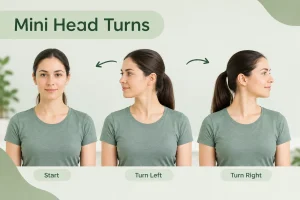
If a full head turn hurts, start small.
- Sit in a supportive chair with your back against it.
- Look straight ahead.
- Rotate your head a short distance to the right, then return to centre.
- Repeat to the left.
- Do 3 to 5 turns on each side.
Go slowly and stay within a range that feels easy. Don’t push to loosen up the stiffness.
- Chin Tucks (Chin Glides)

This builds awareness of where your head sits without tipping it forward.
- Sit tall with your shoulders loose.
- Keep your gaze level.
- Slide your chin straight back, as if making a slight “double chin,” without tilting your head.
- Hold for 2 to 3 seconds.
- Release, and repeat 5 times.
Keep it small. Don’t drop your chin toward your chest, and keep breathing normally.
- Ear-to-Shoulder Tilts
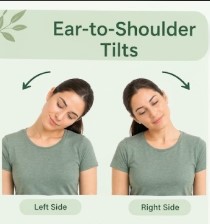
A controlled sideways motion helps keep your neck flexible.
- Sit with your shoulders relaxed.
- Slowly lower your right ear toward your right shoulder.
- Come back to centre.
- Repeat on the left.
- Do 3 to 5 tilts per side.
Don’t let your shoulders rise to meet your ear. Stop right away if you feel sharp pain, dizziness, or sensations travelling into your arm.
- Shoulder Blade Squeezes (Gentle Version)

Neck soreness often comes with tightness across the shoulders and upper back, and this exercise targets that area.
- Sit or stand with your arms hanging loosely.
- Ease your shoulder blades back and slightly down.
- Keep your shoulders away from your ears.
- Hold for 3 seconds, then let go.
- Repeat 6 to 8 times.
Stay relaxed. A hard, forceful squeeze isn’t the goal.
- Slow Shoulder Rolls
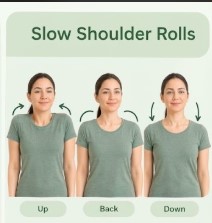
These are a simple way to get moving after a long stretch at a desk.
- Let your arms hang at your sides.
- Raise your shoulders a little.
- Roll them back and down in a smooth, slow circle.
- Do 6 to 8 rolls.
- If it still feels fine, reverse the direction.
Because this works the shoulders rather than stretching the neck itself, it’s a good, easy addition to any routine.
How Much Should You Do?
There’s no single right amount, since everyone’s neck responds differently. If your pain is mild and these exercises suit you, begin with just a few repetitions. Notice how your neck feels during and afterward. If the pain intensifies or spreads, stop and seek medical advice.
Small everyday changes help too. Switch positions through the day, take short movement breaks, and adjust your workspace, for example by raising your screen to eye level so your head isn’t constantly tilted forward.
Common Mistakes to Avoid
Doing these exercises the wrong way can make soreness worse.
- Quick, jerky motions: Keep every movement slow and smooth.
- Pushing into a deeper stretch: More intensity doesn’t mean better results.
- Cracking or forcing your neck: Never wrench or twist it to “release” tightness.
- Brushing off warning signs: Stop if you notice increasing pain, numbness, tingling, or dizziness.
- Exercising after an injury: If your neck pain started after a serious accident, get it checked before trying anything at home.
The goal is comfortable movement, not working through pain.
When to See a Professional
Consider booking a physiotherapist or other healthcare provider if your neck pain keeps coming back, limits how far you can move, or interferes with work or sleep. They can assess your movement and suggest exercises that fit you.
Seek urgent medical care if neck pain follows a major injury, or comes with weakness, trouble walking, loss of coordination, or a severe headache together with fever and a very stiff neck. Pain that travels into the arm along with numbness or tingling also deserves professional evaluation.
Final Thoughts
The best neck pain exercises are the ones that match your comfort level and the cause of your symptoms. Mini head turns, chin tucks, side tilts, shoulder blade squeezes, and shoulder rolls each offer a gentle way to keep moving without aggressive stretching. Start slowly, skip anything that hurts, and get professional guidance if your symptoms linger or worsen. That way your routine can be tailored to you rather than copied from a one-size-fits-all list.