

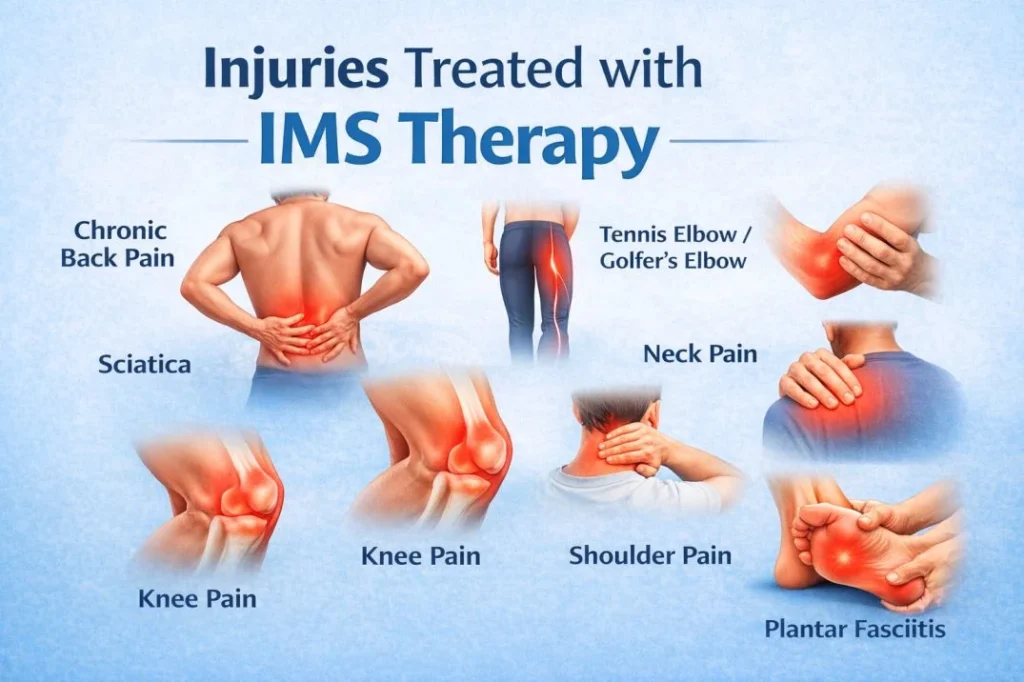
IMS — also known as dry needling — is a proven technique based on the understanding that many cases of chronic pain come from overly sensitive, tight muscles linked to nerve irritation, rather than just structural damage. By inserting a fine, acupuncture-like needle directly into a tight or knotted muscle band, IMS creates a natural twitch response that helps release tension, improve blood flow, and restore proper communication between the muscle and the nervous system. This process supports the body’s own natural healing and recovery.
Unlike cortisone injections that suppress inflammation temporarily, or painkillers that simply dull your perception of pain, IMS addresses the neuromuscular root of the problem. The results are often dramatic — and long-lasting. Here are the seven most common injuries that respond exceptionally well to IMS treatment.
01. Chronic Back & Neck Pain
Back and neck pain are the most frequent reasons patients seek IMS therapy. When spinal nerves become irritated — from poor posture, disc degeneration, or injury — surrounding muscles chronically shorten to guard the area. Over time, this protective tightness becomes the pain itself. IMS needles penetrate deep paraspinal muscles like the multifidi and erector spinae, releasing the grip they’ve developed around compressed joints and discs. Many patients experience a profound reduction in stiffness and pain within just a few sessions, often after years of trying everything else.
02. Rotator Cuff & Shoulder Injuries
Shoulder injuries — whether from sports, repetitive overhead work, or gradual degeneration — frequently involve deep trigger points that standard imaging can’t fully capture. IMS targets the rotator cuff muscles including the infraspinatus, supraspinatus, teres minor, and subscapularis to restore full range of motion and eliminate referred pain that can travel all the way down the arm. Athletes and office workers alike find that IMS dramatically shortens the recovery timeline for shoulder impingement, frozen shoulder, and chronic rotator cuff dysfunction.
03. Tennis Elbow & Repetitive Strain Injuries
Lateral epicondylitis — commonly called tennis elbow — is often misunderstood as purely a local tendon problem. In reality, tight forearm muscles and nerve irritation originating from the cervical spine play a major role. IMS addresses this full chain by treating both the forearm extensors and the corresponding neck segments responsible for the nerve supply to the elbow. This dual approach consistently outperforms bracing, cortisone, and local physio for stubborn cases of tennis elbow and other repetitive strain injuries of the arm and wrist.
04. Hip Pain & Piriformis Syndrome
Deep, aching hip pain — especially piriformis syndrome, where the piriformis muscle clamps around the sciatic nerve — responds remarkably well to IMS. The needle elicits a characteristic twitch in the piriformis that instantly releases the muscular grip on surrounding nerves and connective tissue. Patients suffering from hip impingement, trochanteric bursitis, and post-surgical stiffness consistently report improved mobility and reduced discomfort after IMS, allowing them to walk, climb stairs, and exercise without the constant limitation they had grown accustomed to.
05. Knee Pain & IT Band Syndrome
Knee pain rarely originates in the knee alone. Tight quadriceps, shortened hamstrings, and iliotibial band syndrome all trace back to dysfunctional muscles in the hip and lumbar spine. IMS practitioners map the pain to its upstream neuromuscular source and needle at those root points rather than just around the knee itself. This systemic approach delivers a more complete resolution of knee pain — particularly for runners and cyclists dealing with IT band syndrome, patellofemoral syndrome, and post-injury stiffness that refuses to fully resolve with conventional rehabilitation alone.
06. Sciatica & Nerve-Related Leg Pain
That burning, electric, or shooting pain radiating from your lower back down through your leg is one of the most debilitating conditions IMS treats with consistent success. By releasing the tight paraspinal muscles in the lumbar region and relieving tension in the piriformis, IMS decompresses the sciatic nerve at multiple points along its path. Patients who have endured months or even years of sciatica often describe IMS as the first treatment that delivered real, functional relief — including measurable improvement in numbness, tingling, and the leg weakness that medications and spinal injections rarely fully resolve.
07 Plantar Fasciitis & Chronic Foot Pain
The agonizing heel and arch pain of plantar fasciitis — especially that stabbing first step out of bed each morning — has a neurological component that most treatments ignore. Tight calf muscles, restricted ankle mobility, and irritated lumbar nerve roots all contribute to the chronic tension in the plantar fascia. IMS treats this condition by releasing the gastrocnemius, soleus, and the relevant spinal nerve levels rather than focusing only on the foot. This comprehensive approach produces far more durable results than stretching, orthotics, or local injections for long-standing, treatment-resistant plantar fasciitis.
IMS doesn’t just silence pain — it retrains the nervous system to stop generating it in the first place. That’s the fundamental difference between managing symptoms and achieving genuine, lasting recovery.
What to Expect from IMS Treatment
A typical IMS session lasts between 30 and 45 minutes. Your physiotherapist will assess your posture, range of motion, and nerve sensitivity before identifying the precise muscle segments to treat. The needling itself takes only a few minutes per site, and while the twitch response can feel surprising, most patients describe it as a brief, deep ache rather than sharp pain.
It’s normal to feel increased muscle soreness for 24 to 48 hours after treatment — similar to the feeling after an intense workout. This is a healthy sign that the healing process has been activated. Most patients begin noticing meaningful improvements in pain and mobility within three to six sessions, depending on how long the condition has been present and its complexity.
Is IMS Right for You?
IMS is especially effective for pain that has been present for more than three months, hasn’t responded to conventional physiotherapy or medication, is associated with muscle tightness or nerve sensitivity, or seems out of proportion to any visible injury on imaging. If that sounds familiar, IMS may be the breakthrough your recovery has been missing.
Always consult a certified IMS physiotherapist who will conduct a thorough assessment before treatment. IMS is not suitable for individuals on blood thinners, those with needle phobias, or certain medical conditions — your practitioner will screen for these during your initial consultation.
Ready to Break Free from Chronic Pain?
Book a consultation with a certified IMS physiotherapist today. Whether you’ve been struggling for months or years, IMS offers a proven, drug-free path to restoring your movement, eliminating your pain, and reclaiming the life you deserve.